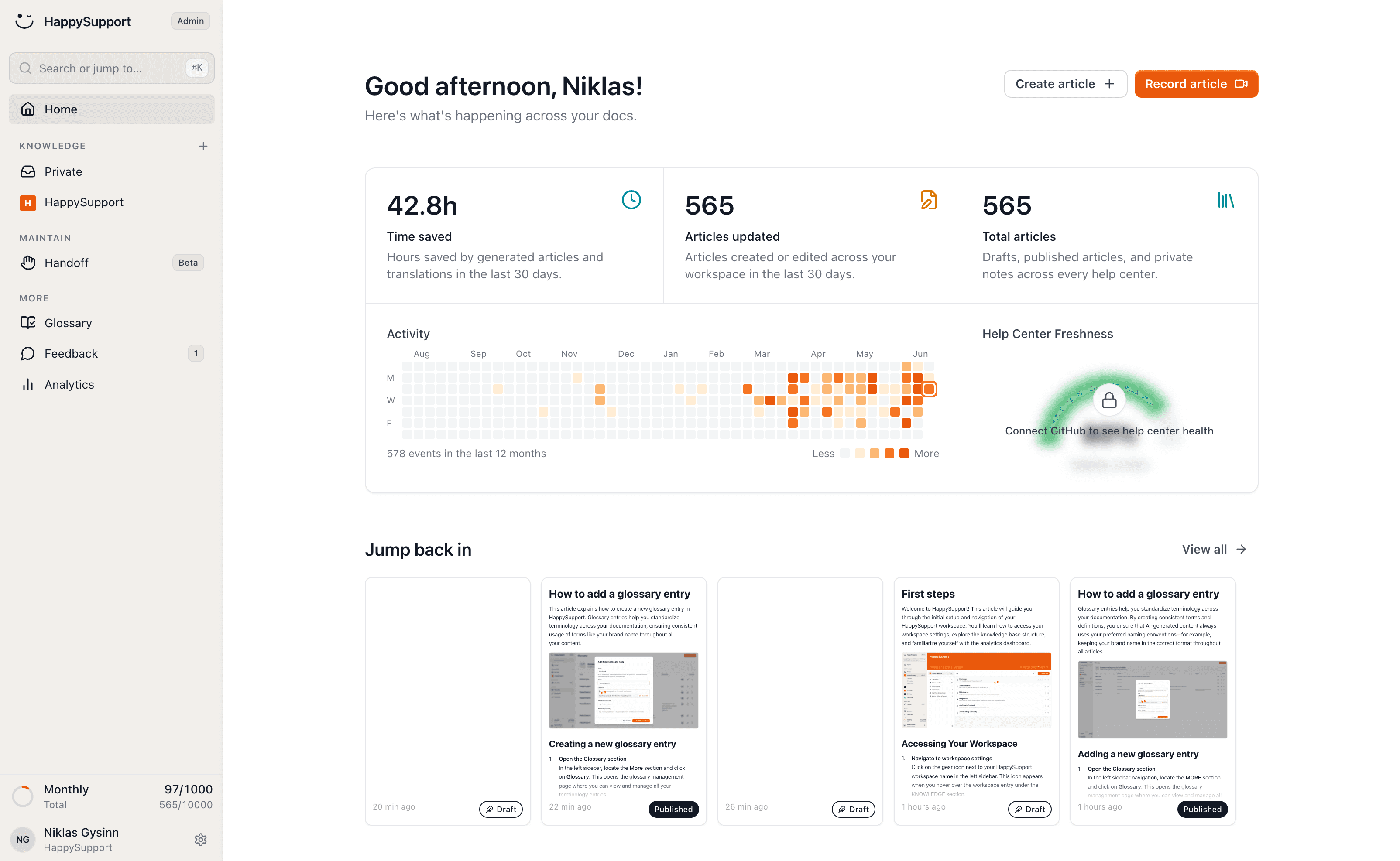
A ticketing system that prevents tickets, not just files them
Ticket inbox, AI chat and knowledge base from one source. Most questions are answered before they ever become a ticket.
Classic help desk software bills per agent. Every extra request turns into a hiring question, and every hiring question into a licence question.
But volume does not fall because tickets are routed faster. It falls when the answer is already there before the ticket.
What is a ticketing system?
A ticketing system collects customer requests in one place and turns them into tickets with a status, a priority and an owner. It makes sure nothing is lost and every request has a traceable history.
That describes the handling, not the volume. How many tickets appear in the first place is decided one layer up: the content customers can help themselves with. That is why HappySupport keeps the knowledge base, the AI chat and the ticket inbox in one product instead of three.
Help desk, ticketing system and service desk
The three words describe the same mechanism from three angles. A ticketing system is the machinery: request in, case out, status attached. Help desk software is that plus everything that makes resolving customer requests faster.
A service desk, in ITIL terms, is the internal IT front door, with assets, changes and incidents. If you are looking for your own customers, you want help desk software, not ITSM.
Why the knowledge base decides your ticket volume
Every request a customer can resolve alone is a ticket that never happens. That only holds while the articles are correct: a help center that is three releases out of date sends people on a detour and then into the contact form anyway.
This is where HappySupport differs from a pure ticketing tool. Documentation is recorded in a click and reconciled with the product automatically, so self-service does not decay with every release.
What help desk software costs
Most vendors bill per agent per month, typically between 15 and 115 euros depending on the tier. That ties your cost to the size of the team, which is the one number you are trying to keep small.
HappySupport is flat: 129, 399 or 899 euros per month, whatever the size of the team. Ticket inbox, help center, AI chat and widget are included, after a 14-day free trial.
What your team actually needs day to day
No configuration project, no automation rules nobody understands six months later.
One inbox
Requests from the contact form, from the in-product widget and from escalated AI chats all arrive in one place.
Reply by email
Your team replies from the inbox, the customer gets a normal email, the thread stays on the ticket.
Internal notes
Notes live on the case and never reach the customer. Reply and note are two buttons in the same editor.
Priority, status, assignee
Every ticket has an owner and a state. A software team rarely needs more process than that.
AI summary on escalation
When the AI chat cannot finish the job, it opens a ticket with the question, the thread and a summary.
User context
When the request comes from the widget inside your product, the known user context is attached to the ticket.
Most questions are answered by the AI chat
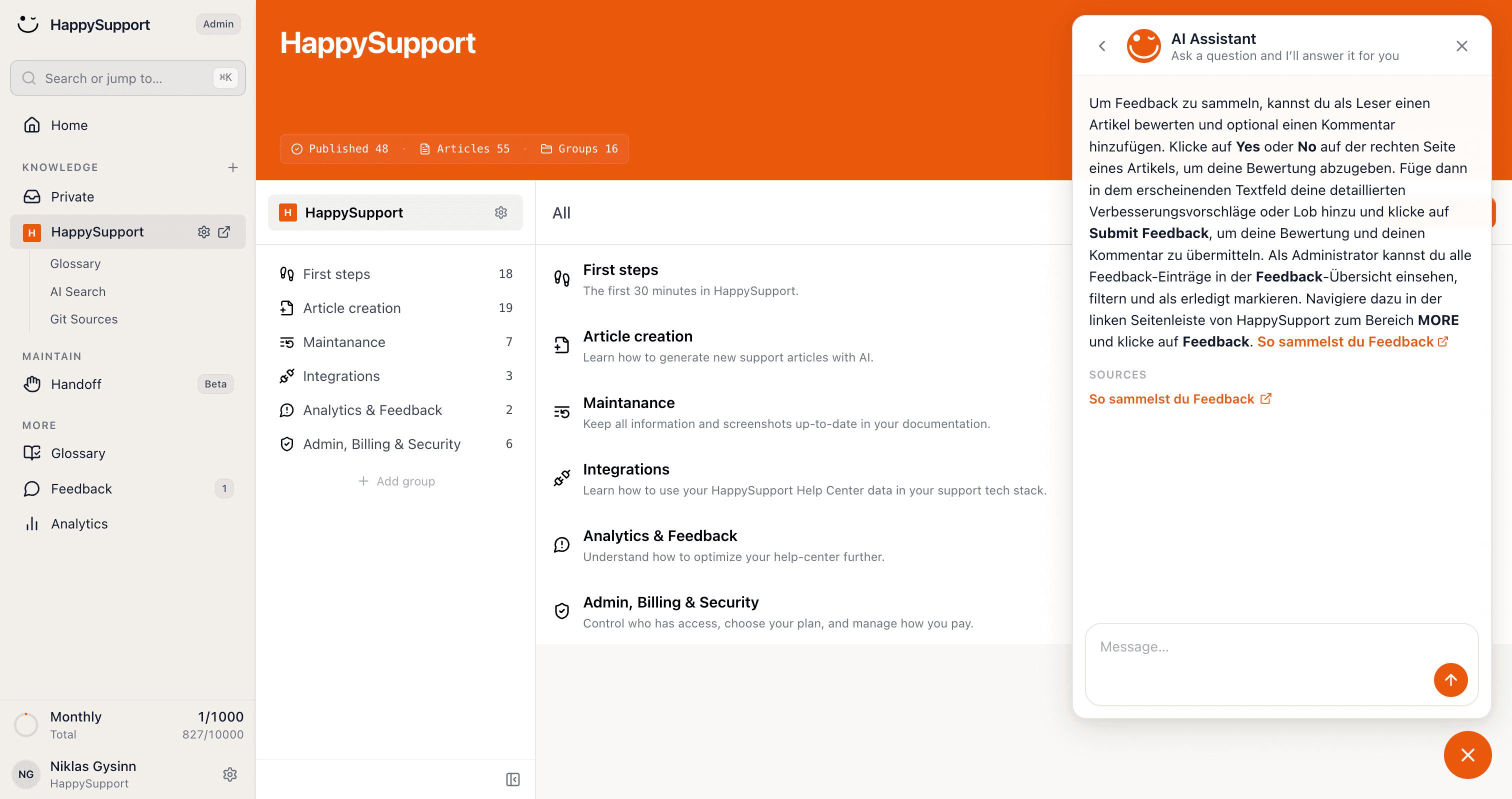
The AI chat answers only from your own articles and names its source. What it cannot answer with confidence, it escalates instead of inventing.
For your team that means the inbox holds the cases that genuinely need a person, not the billing-address question for the fortieth time.
A knowledge base that is still correct after the release
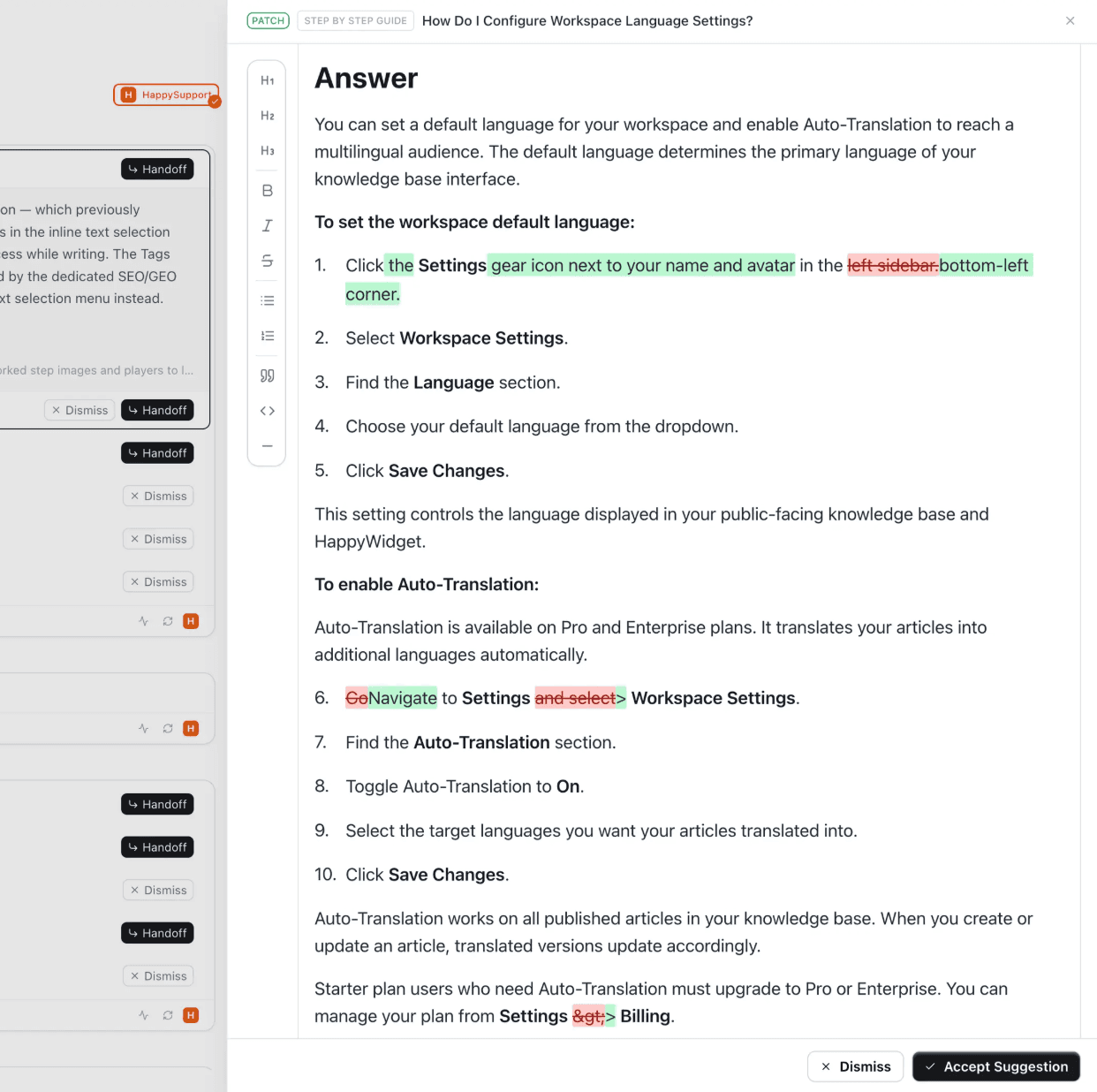
HappySupport detects changes in your product, finds the affected articles and puts finished update suggestions in front of you for review. Self-service stays current without anyone chasing it by hand.
That is the difference between a help center that saves tickets and one that starts producing them six months in.
Next to the ticket inbox
Reduce support tickets
The levers that actually lower volume, in the order they pay off.
AI answers for customer service
How the AI chat answers from your articles, and when it hands over to a person.
The self-service suite
Help center, widget, recorder and inbox as one product instead of four contracts.
Ticketing at HappySupport
What the inbox does, what it deliberately does not do, and what it costs.
Which channels land in the inbox?+
The contact form, the in-product widget and escalated AI chats. Your team replies by email and the thread stays on the ticket. Telephony, social channels and a shared email mailbox with routing rules are not included. If that channel mix is what you need, a classic help desk suite fits better.
What does the ticketing system cost?+
129, 399 or 899 euros per month, flat and independent of team size. There is no per-agent price; after a 14-day free trial you pick a plan. Ticket inbox, help center, AI chat and widget are part of the product rather than add-on modules.
Is the ticketing system GDPR compliant?+
Yes. HappySupport is hosted in Germany, provides a data processing agreement and does not train AI models on your customer data, which is contractually excluded with the model providers. There is no SOC 2 report.
Does HappySupport replace my current help desk?+
For software teams whose requests come from the product and the website, usually yes. Articles from Zendesk and Intercom import in one click and old URLs redirect automatically. If you need telephony, field service or complex automation rules, keep your current system and put HappySupport in front of it for self-service and AI answers.
Do I need a knowledge base before the inbox is useful?+
No, the inbox works from day one. The difference shows after a few weeks: without articles your team handles every question individually, with articles the AI chat handles the repetitive ones. The first 15 articles come out of your most frequent requests and can be recorded rather than written.
Your help center, ready before your coffee.
Start for free and publish your first article today.
 Book a demo