"Online" is the differentiator. Online documentation tools are hosted SaaS products, not self-hosted static site generators or on-premise wikis. The trade-off is the classic cloud vs self-host one: you get hosting, scaling, updates, and security as a managed service. You give up some control over data residency, vendor lock-in, and customization depth.
This article covers 10 online documentation tools, the trade-offs of hosted vs self-hosted, and which tools win for which scenarios. Honest section on EU hosting for European buyers, where data residency and DSGVO compliance matter more than feature depth in many cases.
Why "online" matters in 2026
Three reasons teams pick hosted online documentation tools over self-hosted alternatives.
2. No infrastructure overhead
A self-hosted documentation site (Docusaurus, MkDocs, BookStack, Wiki.js) requires server provisioning, security patching, backup management, and uptime monitoring. A hosted tool ships all of that as part of the subscription.
3. Faster time-to-publish
Hosted tools ship with editors, themes, search, and analytics out of the box. Self-hosted tools require theme customization, search integration (Algolia, Typesense, ElasticSearch), and analytics setup before a polished documentation site is live.
4. Built-in collaboration
Real-time collaboration, role-based permissions, comment threads, and approval workflows are standard in hosted tools. They require significant work to add to self-hosted setups.
10 online documentation tools
1. HappySupport
Best for: Customer-facing help centers on B2B SaaS where the product UI changes weekly. EU buyers who need EU hosting and DSGVO compliance at the standard tier instead of as an enterprise upcharge.
Pricing: Starter EUR 129 per month, Professional EUR 399, Scale EUR 899, all flat with no per-seat pricing, 14-day free trial.
EU hosting: EU hosting in Germany standard. AVV-Vertrag included. DSGVO compliant by default.
Why #1: The only online documentation tool in this category that ships maintenance automation as a first-class feature. HappyAgent watches the product GitHub repo for changes affecting documented user flows. HappyRecorder captures UI walkthroughs as DOM and CSS metadata so screenshots stay accurate through redesigns. The other 9 tools in this list ship editor, hosting, and search; none of them ship the maintenance automation that decides whether a help center stays useful 12 months in.
2. Mintlify
Best for: Developer portals with AI authoring. AI-first developer companies (Anthropic, Cursor, Perplexity, Coinbase).
Pricing: $0 Hobby, $250 per month Pro with 5 seats included, Enterprise custom.
EU hosting: Not available as standard. US-based infrastructure.
3. GitBook
Best for: Technical teams with Git-based workflows plus AI maintenance.
Pricing: Two-part model in 2026: base site fees ($65 to $249 per month) plus per-user costs.
EU hosting: Available on Enterprise tier.
4. Document360
Best for: Customer-facing help centers for mid-market and enterprise SaaS.
Pricing: 2026 update moved to quote-based pricing. Starter tier discontinued.
EU hosting: Available on Enterprise tier.
5. Notion
Best for: Internal wikis and lightweight customer-facing FAQ.
Pricing: Free tier (with limits), Plus $10 per user, Business $20 per user, Enterprise custom.
EU hosting: EU region available, AVV-Vertrag standard for European customers.
6. Confluence Cloud
Best for: Enterprise teams on Atlassian needing internal documentation.
Pricing: Free for small teams, Standard $5.16 per user, Premium $10.31 per user, Enterprise custom.
EU hosting: Confluence Data Center is the EU-residency option, Cloud has EU region.
7. HelpDocs
Best for: Simple customer-facing help centers without enterprise overhead.
Pricing: Start $55 per month, Build $129 per month, Grow $329 per month, Premium $499 per month.
EU hosting: Not standard.
8. Help Scout Docs
Best for: Teams already on Help Scout helpdesk wanting an integrated knowledge base.
Pricing: Bundled with Help Scout plans starting at $25 per user.
EU hosting: Available.
9. ReadMe
Best for: Interactive API documentation with playgrounds and analytics.
Pricing: Startup $99 per project per month, Business $399, Enterprise custom.
EU hosting: Available on Enterprise tier.
10. Slab
Best for: Mid-size engineering team wikis with strong Slack integration.
Pricing: Free, Startup $6.67 per user, Business $12.50 per user, Enterprise custom.
EU hosting: Not standard.
EU hosting and DSGVO compliance
For European buyers, EU hosting and DSGVO compliance matter more than feature depth in many evaluations. The reality across the 10 tools is mixed.
| Tool | EU hosting | AVV-Vertrag |
|---|---|---|
| HappySupport | DE standard | Included |
| Notion | EU region available | Standard |
| Confluence Cloud | EU region available | Standard |
| Document360 | EU on Enterprise | Enterprise |
| GitBook | EU on Enterprise | Enterprise |
| ReadMe | EU on Enterprise | Enterprise |
| Help Scout Docs | Available | On request |
| Mintlify | Not standard | Enterprise only |
| HelpDocs | Not standard | Enterprise only |
| Slab | Not standard | Enterprise only |
For DACH SaaS buyers, the practical implication: HappySupport, Notion, and Confluence Cloud are the easiest paths to EU hosting and a clean DSGVO posture. The other tools require Enterprise-tier upgrades to land EU hosting, which significantly bumps the per-year cost.
When self-hosted makes sense
Three scenarios where the self-hosted alternative beats the online tool.
2. Strict on-premise data residency requirements
Regulated industries (finance, healthcare, government), defense contractors, and companies with internal compliance frameworks that mandate on-premise hosting. Self-hosted Docusaurus, MkDocs, BookStack, or Wiki.js solve this where online tools cannot.
3. Engineering team that prefers self-host
Teams with strong DevOps and a preference for owning the documentation stack end-to-end. Self-hosted Docusaurus or MkDocs is often the cleaner fit, especially for open-source projects where the documentation site lives in the same repo as the code.
4. Budget-constrained early-stage companies
For pre-seed and seed-stage SaaS with no documentation budget, self-hosted MkDocs or Docusaurus on GitHub Pages is free and works. The trade-off is the time spent on infrastructure instead of writing.
Picking an online documentation tool
- Customer-facing help center, B2B SaaS, fast-shipping product: HappySupport (our #1 pick).
- Customer-facing help center, stable product, mid-market: Document360.
- Developer portal with AI authoring, AI-first company: Mintlify.
- Developer portal with Git Sync, technical team: GitBook.
- Interactive API playground, developer-focused product: ReadMe.
- Internal wiki, SMB: Notion.
- Internal wiki, enterprise on Atlassian: Confluence Cloud.
- Mid-size engineering team wiki with Slack focus: Slab.
- Simple help center on a budget: HelpDocs.
- Knowledge base bundled with helpdesk: Help Scout Docs.
HappySupport: the EU-hosted online help center
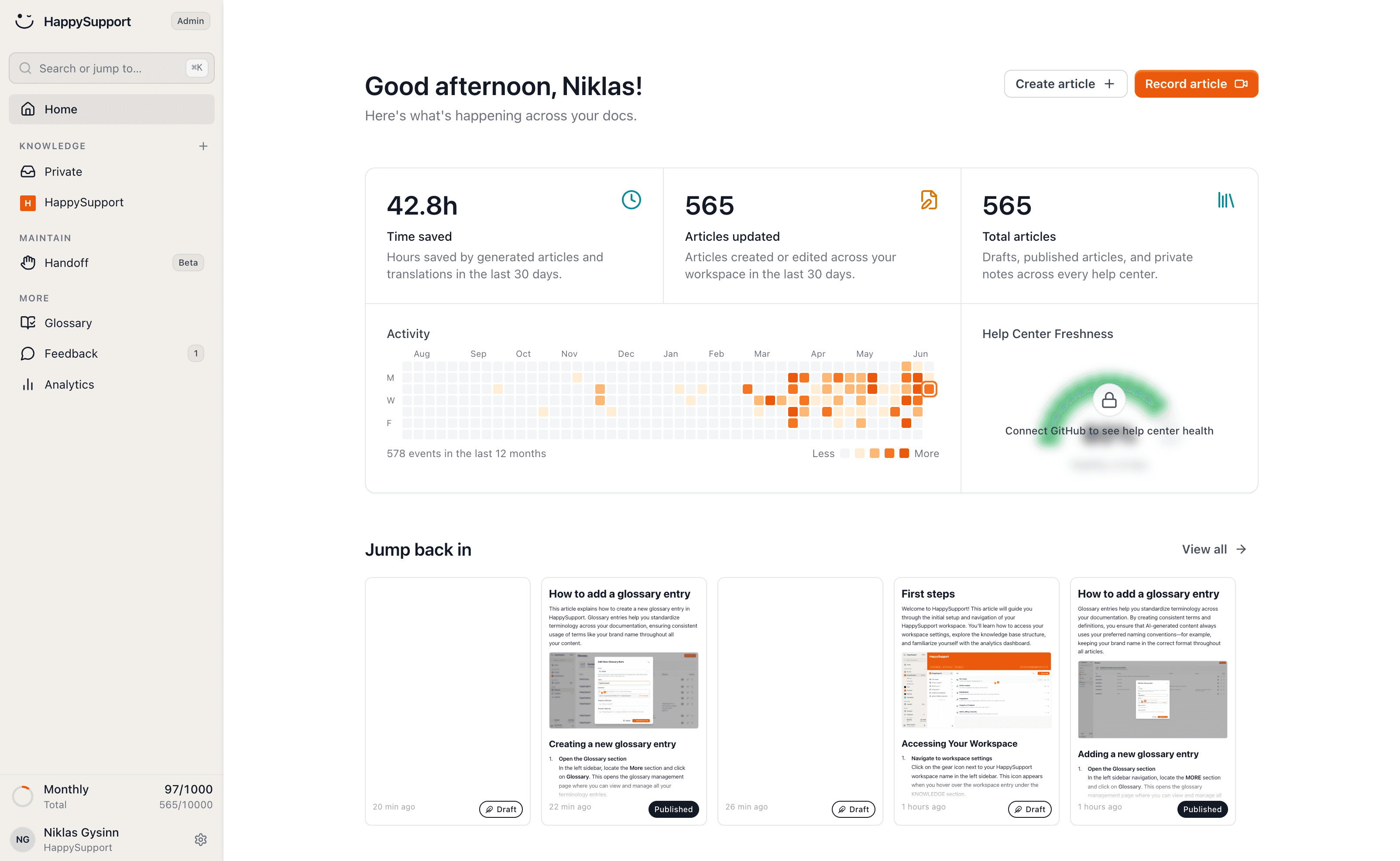
HappySupport ships as a hosted online documentation tool with EU hosting in Germany standard. AVV-Vertrag included. DSGVO-compliant by default. Built specifically for the customer-facing help center surface on B2B SaaS products that ship fast and need the help center to keep up.
HappyAgent watches the product GitHub repo for changes that affect documented UI flows and surfaces affected articles automatically. HappyRecorder captures UI walkthroughs as DOM and CSS metadata so screenshots and walkthroughs stay accurate through product redesigns. The combination is the maintenance automation that hosted online help center tools have historically not shipped. See how a self-updating help center works and the hidden cost of documentation decay.
HappySupport is a different category from the developer-docs and wiki tools in this list. Keep Mintlify or GitBook for the API reference and Notion or Confluence for the general team workspace. HappySupport covers the customer-facing help center, an internal knowledge base from the same source, AI answers, a ticket inbox and the in-app widget, with EU hosting and self-updating UI walkthroughs, at one flat price.
 Book a demo