HappySupport and Ferndesk are the two help center tools built around the same promise: documentation that keeps itself current when the product changes. Both read merged pull requests, both draft article updates that your team reviews, both include an in-app widget with AI answers, and both charge a flat monthly price per plan instead of per agent. The differences are in what surrounds the help center: HappySupport adds a ticket inbox, a screen recorder that turns a click-through into an article, guided in-app tours and hosting in Germany, while Ferndesk adds an OpenAPI reference with a try-it playground, reads tickets from the helpdesk you already use, and costs less to start.
This comparison puts the two side by side on how they keep articles current, what the widget does, how tickets are handled, pricing and hosting, with every Ferndesk claim linked to Ferndesk's own pages (checked October 2026). Our recommendation: pick HappySupport if you want help center, AI chat, ticket inbox and in-app tours in one EU-hosted suite, or if your code lives on GitLab or Bitbucket; pick Ferndesk if you already run Zendesk, Intercom or Help Scout for tickets, need API reference docs next to the help center, or want the lowest entry price.
Disclosure: HappySupport is our product. HappySupport facts come from our facts page and pricing page.
What is Ferndesk?
Ferndesk is an AI-native help center for SaaS companies that describes itself as "the help center that never goes stale". Its AI agent, Fern, checks articles against the product, catches what changed and drafts the fixes, using merged GitHub pull requests, Linear tickets and support tickets from connected helpdesks as signals.
Around the agent, Ferndesk provides a public help center on a custom domain, an in-app widget added with one script tag (search, articles and AI chat), AI conversations answered from your verified docs, private docs behind magic link, OIDC or JWT access, analytics on searches, missed searches and failed answers, and an OpenAPI reference with a try-it playground, according to the Ferndesk homepage. Ferndesk does not run its own ticket inbox; it reads tickets from Zendesk, Intercom, Help Scout and Discord.
What is HappySupport?
HappySupport is a customer support suite for software companies, built around a help center that keeps itself current: help center, AI chatbot, ticket inbox and in-app widget, all fed from one source of content. HappySupport is built and run in Stuttgart and Heilbronn, Germany, and hosts customer data in Germany.
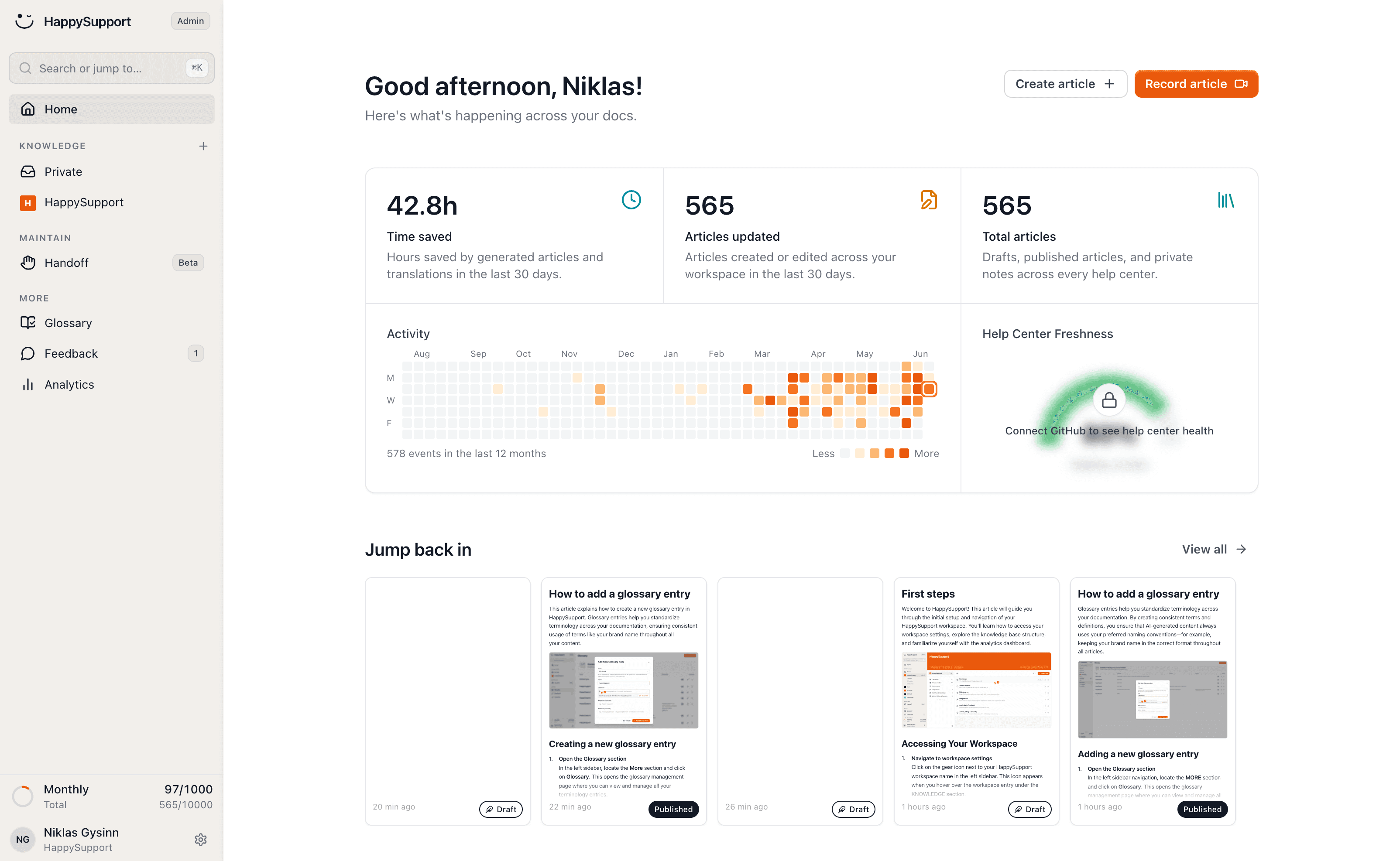
HappySupport's content starts with the HappyRecorder, a Chrome extension or Windows app that turns one click-through of your product into a step-by-step article with screenshots in under a minute. Git Handoff then reads commits and pull requests from GitHub, GitLab or Bitbucket, finds the articles a change affects and prepares update proposals that your team reviews and accepts. The same articles feed the AI chatbot, which answers only from your own content with sources, and the in-app widget with search, AI chat, banners and a contact form; guided in-app tours run on the Scale plan.
HappySupport vs Ferndesk at a glance
HappySupport and Ferndesk overlap on the core loop (code change, drafted article update, human review) and differ on the parts around it. The table summarises the differences; each row is explained in the sections below.
| Ferndesk | HappySupport | |
|---|---|---|
| Keeps articles current from | Merged GitHub PRs, Linear, helpdesk tickets, scheduled audits | Commits and PRs on GitHub, GitLab or Bitbucket |
| How articles are created | AI drafting, automated screenshots | HappyRecorder click-through, AI writer |
| In-app widget | Search, articles, AI chat | Search, AI chat, contact form, banners; guided tours on Scale |
| Ticket handling | Reads tickets from Zendesk, Intercom, Help Scout, Discord | Own ticket inbox with email replies and AI handoff |
| API reference | OpenAPI reference with try-it playground | Not included |
| Entry price | $149 per month (Pro), $75 early-stage rate | 129 EUR per month billed yearly (155 EUR monthly), excl. VAT (Starter) |
| Free trial | 7 days | 14 days |
| Hosting | No hosting region stated on the pages we checked | Germany (AWS Frankfurt, Netcup), GDPR |
How each tool keeps documentation current
Both HappySupport and Ferndesk start from a code change and end with a drafted update that a person approves, so neither publishes silently. Ferndesk lists "automatic PR screening" and "scheduled audits" on every paid plan, according to Ferndesk's pricing page, and its help center defines a PR review as Fern checking a merged pull request against your documentation to detect gaps or stale content (Ferndesk help).
Ferndesk reads more kinds of signal than code: Linear tickets and support tickets from your helpdesk also feed Fern, which helps find articles that are missing rather than wrong. HappySupport's Git Handoff reads the repository only, groups the commits into topics, and proposes updates and new drafts for the affected articles.
HappySupport ties recorded guides to the interface itself. Every step recorded in the browser is anchored to a DOM or CSS selector chain captured during recording, a method HappySupport calls code-anchored documentation, so a change to the frontend source can be traced to the guides that show that part of the interface. The detect affected articles page shows what the proposals look like.
The code host matters in practice. HappySupport supports GitHub, GitLab and Bitbucket. Ferndesk documents a GitHub connection; we found no GitLab or Bitbucket integration on Ferndesk's pages.
Creating articles and screenshots
HappySupport and Ferndesk create the first version of an article differently. HappySupport's HappyRecorder records a click-through and writes the article with numbered steps, screenshots and a demo GIF, hiding sensitive data in the screenshots; from the Professional plan, single screenshots are re-captured automatically when the interface changes.
Ferndesk drafts articles with AI and lists "automated screenshots in your docs" and image editing on its homepage. We did not find a step recorder in Ferndesk's product pages, so teams that document UI workflows by clicking through them get more from HappySupport's recorder.
In-app widget and AI answers
Both HappySupport and Ferndesk put search, articles and AI chat inside your product with one snippet of code. HappySupport's widget also carries a contact form that opens a ticket, in-app banners with audience targeting (Scale) and guided in-app tours built from the same articles (Scale), so a tour updates together with its article.
AI answers are metered differently. Ferndesk counts AI answers per conversation, so one conversation with several questions counts once (Ferndesk help). HappySupport counts each AI answer, with 250 per month on Professional and 1,000 on Scale. Both pause AI answers when the allowance runs out instead of charging overage, and both let you buy more (Ferndesk help, HappySupport pricing).
Tickets and support workflow
Ticket handling is the clearest structural difference between HappySupport and Ferndesk. Ferndesk reads tickets from Zendesk, Intercom, Help Scout and Discord to find documentation gaps and leaves the support conversation in that tool. HappySupport has its own ticket inbox: when the AI chat cannot help, it hands the conversation to your team and opens a ticket with an AI summary, the page the customer was on and the articles they already read, and the team replies by email.
Teams that already run a helpdesk they are happy with lose nothing with Ferndesk's approach. Teams without a helpdesk, or that want help center and tickets in one place, need a second tool next to Ferndesk and do not next to HappySupport. HappySupport's inbox is deliberately small: no phone channel, no omnichannel routing and no workforce management.
Ferndesk pricing
Ferndesk Pro costs $149 per month, or $1,490 per year, flat per workspace with 5 seats, unlimited articles, 1,000 AI conversations per month and 5 languages, according to Ferndesk's pricing page (checked October 2026). Companies before seed or under $1M ARR with fewer than 10 people pay $75 per month for the first 12 months. Enterprise starts at $399 per month with 2,500 conversations, SSO (SAML), SCIM and a data processing agreement. There is a 7-day free trial and no free plan.
HappySupport costs 129 EUR (Starter), 399 EUR (Professional) or 899 EUR (Scale) per month, billed yearly (155, 479 or 1,079 EUR billed monthly), excl. VAT, after a 14-day free trial, flat per plan with no per-seat and no per-resolution fee. The plans include 50, 300 or 750 active articles, 1, 5 or 10 team members, and no, 250 or 1,000 customer AI answers per month; Git Handoff starts on Professional, and SSO, banners and guided tours on Scale. Extra capacity is available on request: 89 EUR per month per 100 articles and 100 EUR per month per 250 AI answers, billed yearly (107 and 120 EUR billed monthly), excl. VAT.
| Ferndesk | HappySupport | |
|---|---|---|
| Entry plan | Pro, $149/month (5 seats) | Starter, 129 EUR/month billed yearly (155 EUR monthly), excl. VAT (1 team member, no AI answers, no Git Handoff) |
| Plan with code-change updates and AI answers | Pro, $149/month | Professional, 399 EUR/month billed yearly (479 EUR monthly), excl. VAT (5 team members) |
| Top plan | Enterprise, from $399/month | Scale, 899 EUR/month billed yearly (1,079 EUR monthly), excl. VAT |
| Articles | Unlimited | 50, 300 or 750 active, plus add-ons |
| AI answers | 1,000 conversations (Pro), 2,500 (Enterprise) | 250 (Professional), 1,000 (Scale) |
| SSO | Enterprise | Scale |
| Free trial | 7 days | 14 days |
On price alone, Ferndesk is cheaper for the same core loop: Ferndesk Pro at $149 includes PR screening and AI conversations, which on HappySupport start with Professional at 399 EUR a month, billed yearly (479 EUR billed monthly), excl. VAT. The HappySupport price also covers the ticket inbox and the recorder, so the fair comparison is Ferndesk plus your helpdesk against HappySupport alone.
Hosting and compliance
HappySupport hosts customer data in Germany on AWS Frankfurt and Netcup, is GDPR compliant, offers a DPA and never uses customer data for AI training; AI processing runs in the EU, on Microsoft Azure OpenAI in Sweden and Amazon Bedrock, as listed on the facts page. HappySupport is not SOC 2 certified and offers no SCIM.
Ferndesk lists a data processing agreement and SCIM on its Enterprise plan (Ferndesk pricing). We found no hosting region or SOC 2 statement on the Ferndesk pages we checked, so ask Ferndesk directly if data residency matters to you.
Ferndesk alternatives
The main Ferndesk alternatives depend on which part of Ferndesk you need. For a help center that updates from code changes with a ticket inbox included, HappySupport is the closest alternative. For developer documentation that lives in the repository, Mintlify and GitBook are the usual choices, and the AI documentation tools ranking compares them. For a help center inside the helpdesk you already use, Zendesk Guide, Intercom Articles and Help Scout Docs are the default picks, and the in-app help widget comparison covers their widgets.
Help center tools without code-change updates, such as HelpDocs and Document360, fit teams whose product changes slowly or who have a writer who owns maintenance. The cost of that manual loop is covered in what documentation decay costs a support team.
Which one to pick
Choose Ferndesk if you already run Zendesk, Intercom, Help Scout or Discord for support, your code is on GitHub, you also publish an API reference, or you want the lowest price for a help center with AI answers and PR screening.
Choose HappySupport if you want help center, AI chat, ticket inbox and in-app widget in one suite, your code is on GitLab or Bitbucket, you document UI workflows by clicking through them, you want guided in-app tours that update with their articles, or you need hosting in Germany.
Both tools solve the problem that matters most for a team shipping weekly: the knowledge article's useful life gets shorter with every release, and a help center needs a maintenance loop tied to the release, not to the calendar. For more on that loop, see how to build a help center for a fast-moving SaaS product and how a current help center reduces support tickets.
 Book a demo